PAACS Theory of Change
The Need
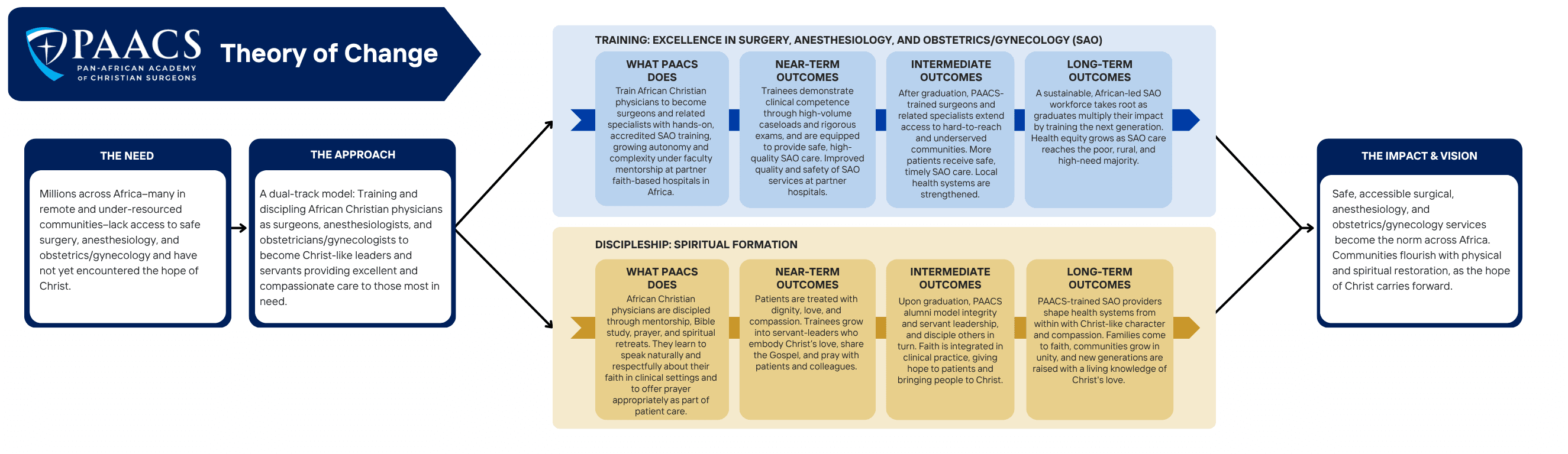
Sub-Saharan Africa faces a critical shortage of surgeons, anesthesiologists, and obstetrician/gynecologists with 93% of the population unable to access life-saving surgical care. Obstetric emergencies, trauma, congenital anomalies, and hernias too
often result in preventable death or disability-particularly among people who live below the poverty line in remote areas. At the same time, more than 535 million people across Africa have yet to hear of Christ or experience the hope that Christ offers.
Our Mission and Approach
PAACS' mission is to glorify God by training and discipling African surgeons, anesthesiologists, and obstetrician/gynecologists to become Christ-like leaders and servants who respond to both the urgent surgical and spiritual needs through ministry to the poor, the sick, and the suffering.
PAACS pursues this mission through a dual-track approach: high-quality surgical and related specialty training and Christian discipleship-PAACS affirms that both are essential to human flourishing. Whole healing requires both physical and spiritual
restoration. When Jesus healed, he healed more than the body; he restored spirit, dignity, and community. In that same way, PAACS seeks to train surgeons, anesthesiologists, and obstetrician/gynecologists who care for the physical and spiritual alike, embodying Christ's compassion through skilled hands and faithful hearts.
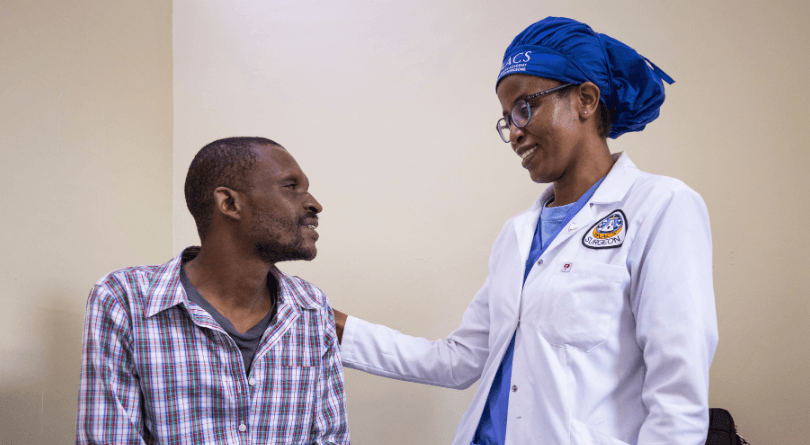
Change begins as residents initiate training that blends academic rigor with spiritual growth.
Training and Discipleship in Action
PAACS delivers accredited residency and fellowship programs hosted at partner faith-based hospitals across Africa. Responding to God's calling, trainees enter rigorous surgical, anesthesiology, and obstetrics/gynecology training to prepare them to provide safe, high-quality care. As learners progress, they gain increasing autonomy in more complex, hands-on care across a broader scope under the close mentorship of PAA CS faculty. At each stage of training, learners demonstrate growing competence by passing demanding periodic examinations in both surgical knowledge and technical skill, reflecting PAACS's standards of academic excellence.
In addition to providing excellent clinical care, PAACS equips them with tools to train and mentor others.
Alongside clinical training, PAACS cultivates spiritual growth through intentional Christian discipleship-mentorship, Bible study, and prayer-helping residents develop into servant-leaders who embody Christ's love and depend on prayer as a daily practice of care and compassion.
Discipleship within PAACS goes beyond weekly devotions. Discipleship is a way of life-living, working, and learning together in a close-knit community, a family. Residents are shaped not only by what they are taught, but also by what they witness daily among PAACS faculty: humility, grace under pressure, and compassion in action. They observe faith lived out in the operating room, at the bedside, and in the quiet moments of prayer shared with patients and colleagues. This shared life of faith and service nurtures both professional excellence and spiritual maturity, forming surgeons and related specialists who lead with integrity and empathy. Through prayer, PAACS entrusts each trainee-and each life they touch-to the healing power of Christ.
From this rhythm of learning, faith, and shared life, transformation begins to take root-first in the residents and fellows themselves, then in the patients, hospitals, and communities they serve.
This dual-track training leads directly to changed lives among PAACS residents and those they serve.
The Impact
PAACS helps widen the circle of transformation by raising the standards of surgical care and expanding access to safe, affordable, and compassionate surgery and specialty care in underserved areas across Africa. Health equity grows as surgical care and specialty services reach the poor and rural majority, reducing the gap between those who have access to essential care and those who do not.
Surgery can restore the potential of a person made in God's image-a child returning to school to flourish, a man resuming work that supports his family, and a mother giving birth safely to a healthy baby. These restored lives strengthen families and communities physically and economically. Every $1 invested in local surgical capacity returns $10 in increased productivity and improved health,1 laying the foundation for more stable, resilient societies. A 2025 study found that countries with higher levels
of surgical activity tend to have higher incomes per person, even accounting for other economic factors.2
PAACS graduates strengthen hospitals. They train future residents, mentor colleagues, and disciple others, creating a multiplier effect that grows exponentially across generations. Each graduate carries the PAACS model into new hospitals, programs, and countries-expanding access to care while forming new communities of faith and service.
While patients receive excellent clinical care, they are also treated with dignity, love, compassion, and prayer in moments of great vulnerability. Through prayer, presence, and compassionate witness, patients and families encounter the love of Christ in
tangible ways. As PAACS-trained surgeons and related specialists model Christ-centered leadership, they bring the hope of the Gospel into every bedside, operating room, hospital, and community they touch. Some come to faith through these encounters, and the change that begins in one heart can spread across a family or community-bringing generational transformation marked by renewed hope, resilience, and faith.
The work of PAACS surgeons and related specialists restores and sustains wholeness-body, soul, and community-through the power of Christ-centered care.
1 Disease Control Priorities, 3rd Edition, Volume 1: Essential Surgery (De bas HT, Donkor P, Gawande A, Jamison DT, Kruk ME, Mock CN, eds), published by The World Bank and Oxford University Press in 2015.
2 lfeanyichi M, Nchege JE, Aduku EB, Kebede MA, Bognini M, Hargest R, et al. Association of surgery and economic development in low- and middle-income countries: evidence from a dynamic panel data analysis. BMJ Global Health. 2026;11:e021115. https:// doi.org/10.1136/bmjgh-2025-021115
Vision of Change
PAACS envisions an Africa no longer defined by its shortage of surgeons but by hope and a thriving, African-led community of Christian physicians who train, lead, and disciple the next generation in their place. As this movement grows, safe, accessible
surgical care becomes the norm rather than the exception, and each life restored carries the hope of Christ forward.


